Case study 01 · 2025
Making call flows readable at a glance.
Role — Product design, research, rollout
Product — Enterprise CTI platform
Migration — Mar–Jun 2025
Context
An enterprise CTI (cloud phone) product lets administrators configure inbound call flows: which group rings, what happens when no one answers, IVR menus, hunting logic, and more. The v1 screen used a flowchart layout, but technical constraints made incremental improvement difficult — so a complete redesign was approved.
The problem
Once a flow branched, nobody could see its full shape.
I interviewed customer success, the internal team closest to customers, to surface the pain points they heard day to day. The most common frustration was clear: branch lines could disconnect when downstream elements moved, and overlap made complex flows difficult to read. Users asked for drag-to-reorder, clearer deletion behavior, in-place previews of sounds and groups, validation for invalid combinations, and an overview they could trust.

The decision
Choose overview over literal branching.
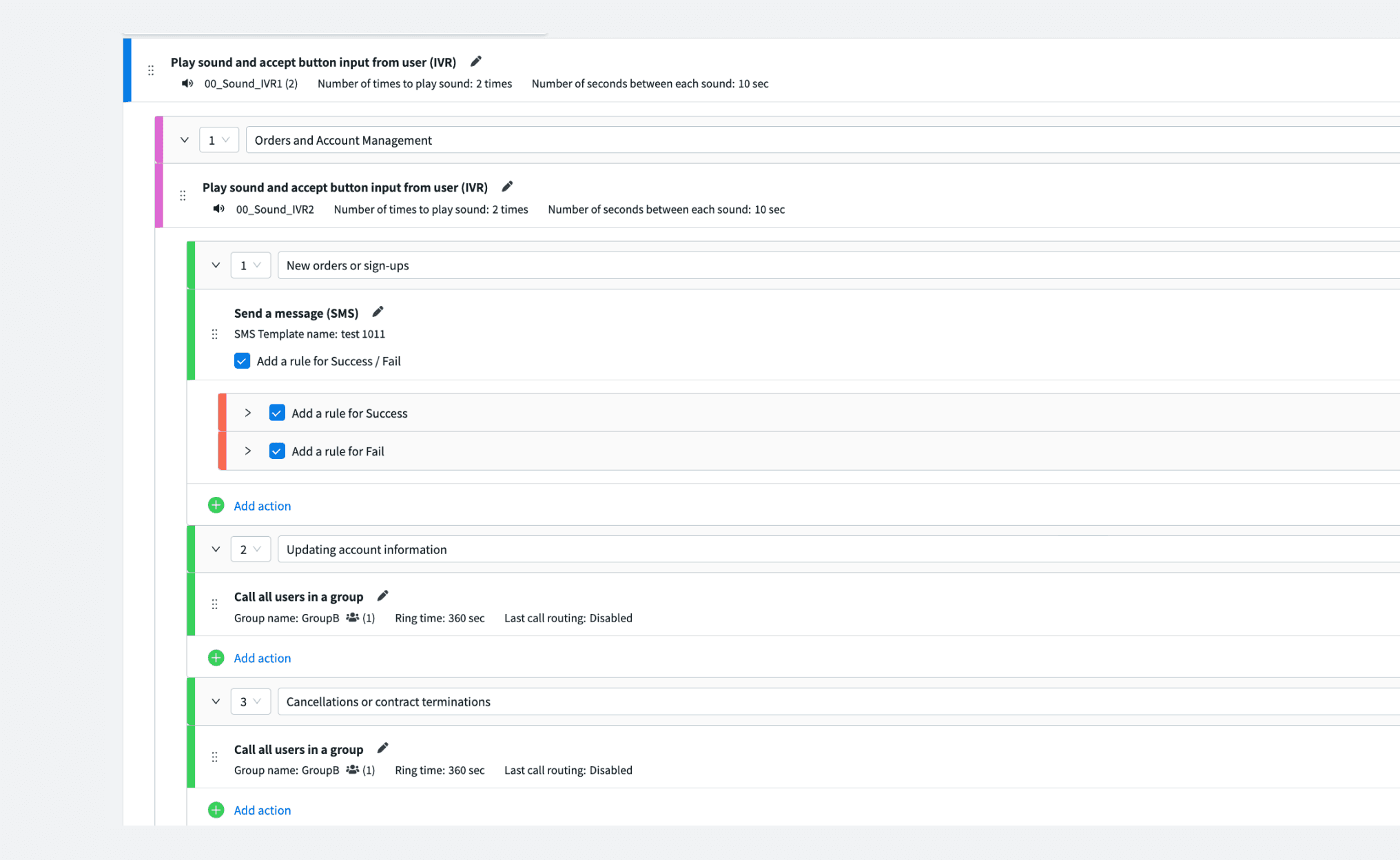
A flowchart-style approach — nodes connected by branching lines — was also considered. But customer success was unanimous: a list-style layout, already used by other companies in the space, was far easier to follow. I adopted a top-to-bottom list, with details collapsible so the full flow stays visible at a glance.
One idea during the redesign was to make the flowchart-style branching explicit, showing both the “Yes” (call answered) and “No” (call continues) paths. But the existing UI had never shown that either, and no one had asked for it — the overview problem was the loud, consistent ask. I prioritized that instead, and used depth color-coding to preserve orientation as IVR branches nested.
Execution
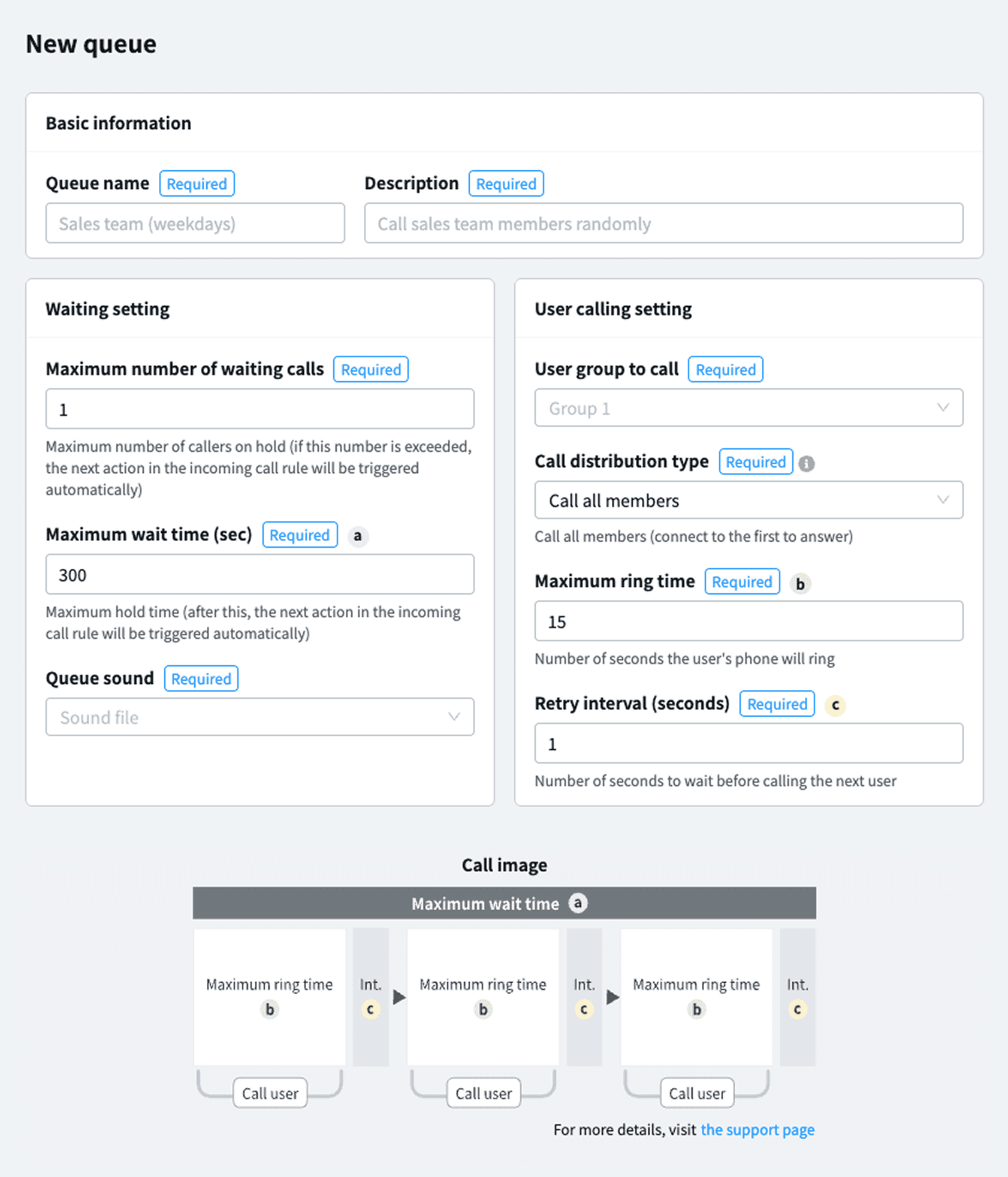
The new experience introduced collapsible steps, drag-to-reorder, in-place sound and group previews, direct creation of related sub-components, and safer deletion behavior. I also redesigned the adjacent queuing settings with a visual setup diagram and more scannable tables.
26 Mar 2025
V2 opt-in preview launched
23 Apr 2025
V2 became the default experience
25 Jun 2025
V1 access removed; migration complete

Outcome
A threefold drop in monthly call-flow inquiries after migration.
15.2 / month
V1 only · pre-release baseline
5.5 / month
V2 only · post-migration
Support tickets tagged with “call flow rule” fell from about 15.2 to 5.5 per month after the full migration. During the transition, the rate rose modestly while both UIs remained available — an expected cost of avoiding an abrupt forced switch.
A note on the data
This is a keyword-match count across ticket subjects and descriptions, not a manual classification of every inquiry. The change should be read as a reduction in overall feature-area inquiries, rather than a precisely isolated UI effect.